Custom Metal Fabrication Shop
Overview
Preserved Shop Record: santourian.com The preserved pages describe a precision sheet metal fabrication and CNC machine shop operating as Santourian Manufacturing Inc., or SMI. The record shows a shop built around build-to-print manufacturing, with sheet metal fabrication, stamping, forming, machining, assembly, welding, and turnkey work gathered under one roof. The language is process language: punching, forming, engraving, machining, welding, assembly, quality, CAD control, and job shop tracking. The shop record presents itself as a full-service operation serving OEM and industrial sectors, with prototype through high-production capability. The preserved homepage language emphasizes technology for fast production. It names twin turret presses, a punching cell with automatic loading and unloading, and large Wiedemann 40-station turret punch presses. It also names three 10,000 rpm Haas
Details
vertical machining centers. Real-time shop floor control is described as a way to see job status without walking down the hall. The record frames this as cyber manufacturing: using technology hand in hand with customers to compete in a global economy. The shop record also states that capacity had doubled and that the operation was committed to customer satisfaction. The process vocabulary is consistent across the preserved pages. CAD control appears alongside punching, machining, forming, engraving, assembly, and quality. The shop describes itself as a precision sheet metal fabrication and CNC machine shop. It lists sheet metal fabrication, sheet metal stampings, CNC machined parts, metal forming, and certified welding as service categories. The record says the shop specializes in steel and aluminum fabrication, build-per-print items such as assemblies, chassis, weldments, frames, ruggedized enclosures, heat sinks, and bus bars. It also states that high quality standards in sheet metal fabrication and CNC machining put the shop one step ahead of competition. Materials are part of the preserved process language. The record lists sheet, bar, plate, and structural materials. Aluminum is listed in 2000, 5000, 6000, and 7000 series. Red metals include brass, bronze, and copper. Steels include low and high carbon steels, with CRS, HRS, CD, CF, and structural designations. Exotic alloys include Inconel, Monel, 4130, 4140, and titanium. Stainless steel includes chromium nickel grades 301, 303, 304, and 316, and chromium grades 410 and 440. Plastics include ABS, Acetal, Delrin, HDPE, G-Classes, Lexan, and Nylon. This material list belongs to the shop's fabrication, stamping, forming, and CNC machining language. The preserved pages also describe machining and welding capabilities. CNC milling is listed as 4-axis, high-speed, with drilling and tapping at 10,000 rpm. Welding services are described as certified welding, with MIL-STD-2219, MIL-STD-1595, AWS D1.1, AWS D1.2, AWS D1.3, and AWS D1.6 named in the record. The shop record also states ISO 9000 compliant. These are preserved claims from the pages, not new certifications. The record also mentions registration with the DDTC and RoHS compliance. The shop describes prototype or high-production metal fabrication capability. The tolerance page gives a useful view of the shop's process thinking. It says that fifty years ago, build-to-order sheet metal tolerances were plus or minus .06 inch, or 1.5 mm, primarily due to equipment accuracy. Today, normal production tolerances are around ten percent of that. The record discusses reasonable or practical tolerance ranges. It notes that tighter tolerances can be achieved with dedicated tooling and special processing. The most significant improvement is in machinery. Some modern high-speed equipment can position within .0028 inch, or .07 mm, and repeat within .002 inch, or .05 mm. Materials and methods still influence practical tolerances between holes, between folds, and so forth. This is process language about hole-to-hole and fold-to-fold relationships, not a quotation. The preserved pages also show a job shop tracking and delivery language. The record says time after time SMI delivers the right mixture of turn-around-time and quality. It describes a build-to-print manufacturer. It mentions uploading files and requesting a quote, but the preserved record does not quote from this domain. The record also lists CAD design services, assembly integration, welding shop services, metal forming shop, CNC machine shop services, and sheet metal fabrication. The navigation includes home, CAD control, punching, machining, forming, engraving, assembly, quality, employment, company, e-mail, and map. The record also notes a family history connected to Apollo 11, and an achievement award from General Atomic Aeronautical for 100 percent quality and 100 percent on-time delivery three years in a row. The shop record also names service geography. It describes manufacturing for San Diego County, Orange County, Los Angeles, Arizona, Nevada, Utah, and the Southwest area. It says the facility is near San Diego in Oceanside, with two buildings. The record states the shop has been a full-service certified welding shop since 1981. It describes professional and experienced staff, consistent CNC manufacturing performance, and award-winning highest quality industrial products delivered on time. The record also lists expert CNC machine shop services, precision sheet metal shop fabrication, CNC stamping, metal forming, CNC machining, and engineering. For a custom metal fabrication shop, the preserved process language points to a build-to-print workflow. The shop takes a print or solid model, uses CAD control, and moves the job through punching, machining, forming, engraving, assembly, and quality. The shop can handle sheet, bar, plate, and structural materials. It can produce assemblies, chassis, weldments, frames, ruggedized enclosures, heat sinks, and bus bars. It can run prototype or high production. It can weld to named standards and machine at high speed. It can track jobs in real time. It can deliver to OEM and industrial sectors across the Southwest. The preserved record does not quote from this domain. It is a shop record: a description of capabilities, materials, equipment, tolerances, and process flow. The language stays inside the shop's own vocabulary. It is about punching, forming, machining, welding, assembly, quality, and delivery. It is about build-to-print manufacturing. It is about precision sheet metal fabrication and CNC machining. It is about the shop floor and the customer's print. It is about turning material into parts and assemblies, and doing so with technology, hand in hand with customers.
Drill size reference
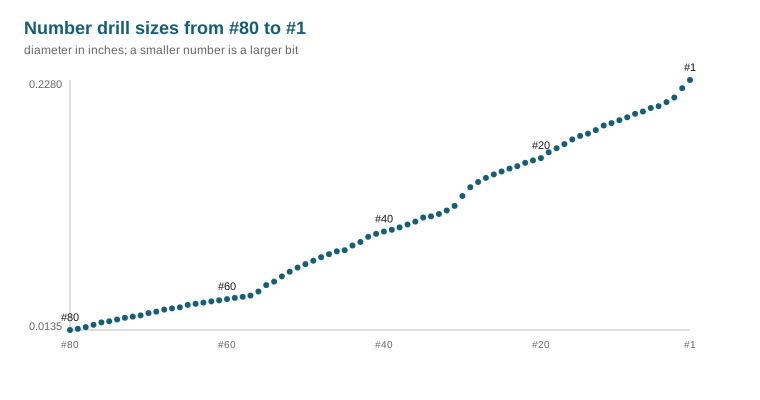
| Drill | Decimal inch | Millimetres |
|---|---|---|
| #1 | 0.2280 | 5.791 |
| #7 | 0.2010 | 5.105 |
| #13 | 0.1850 | 4.699 |
| #21 | 0.1590 | 4.039 |
| #29 | 0.1360 | 3.454 |
| #36 | 0.1065 | 2.705 |
| #43 | 0.0890 | 2.261 |
| #53 | 0.0595 | 1.511 |
| 1/16 | 0.0625 | 1.587 |
| 5/64 | 0.0781 | 1.984 |
| 3/32 | 0.0938 | 2.381 |
| 7/64 | 0.1094 | 2.778 |
| 1/8 | 0.1250 | 3.175 |
| 9/64 | 0.1406 | 3.572 |
| 5/32 | 0.1562 | 3.969 |
| 11/64 | 0.1719 | 4.366 |
| 3/16 | 0.1875 | 4.763 |
| 13/64 | 0.2031 | 5.159 |
| 7/32 | 0.2188 | 5.556 |
| 15/64 | 0.2344 | 5.953 |
| 1/4 | 0.2500 | 6.350 |
| 5/16 | 0.3125 | 7.938 |
| 3/8 | 0.3750 | 9.525 |
| 7/16 | 0.4375 | 11.113 |
| 1/2 | 0.5000 | 12.700 |
| F | 0.2570 | 6.528 |
| H | 0.2660 | 6.756 |
| L | 0.2900 | 7.366 |
| P | 0.3230 | 8.204 |
| S | 0.3480 | 8.839 |
| W | 0.3860 | 9.804 |
| Z | 0.4130 | 10.490 |
Common questions
What is a #1 drill bit in inches and millimetres?
A #1 drill bit is 0.2280 in, which is 5.791 mm. Number drills run from #80 at 0.0135 in up to #1 at 0.2280 in, so a smaller number is always a larger bit.
What is a #7 drill bit in inches and millimetres?
A #7 drill bit is 0.2010 in, which is 5.105 mm. Number drills run from #80 at 0.0135 in up to #1 at 0.2280 in, so a smaller number is always a larger bit.
What is a #13 drill bit in inches and millimetres?
A #13 drill bit is 0.1850 in, which is 4.699 mm. Number drills run from #80 at 0.0135 in up to #1 at 0.2280 in, so a smaller number is always a larger bit.
This page is an archival note for informational purposes only. It does not offer representation, evaluate claims, or create a professional relationship.