Precision Metal Stamping
Overview
Preserved Shop Record: santourian.com Subject: Precision Metal Stamping The preserved pages of santourian.com describe a shop that has been manufacturing since 1981 in Oceanside, California, within San Diego County. The record shows a facility organized around precision sheet metal fabrication and a full CNC machine shop, with stamping named as one of the core processes alongside forming, machining, welding, and assembly. The shop describes itself as a build-to-print manufacturer serving OEM and industrial sectors, and it lists stampings among the items it produces. The preserved text also notes two buildings, a punching cell with automatic loading and unloading, twin Wiedemann 40-station turret punch presses, and three 10,000 rpm Haas vertical machining centers. Those details frame how precision metal stamping is discussed in this shop's own process language. The shop's stamping work
Details
sits inside a broader fabrication sequence. The preserved navigation lists CAD, control, punching, machining, forming, engraving, assembly, and quality. Stamping is not presented as an isolated operation but as one station in a chain that begins with engineering and CAD design services and continues through forming, welding, assembly integration, and job shop tracking. The record states that the shop is a build-to-print manufacturer, meaning the print governs the work. Materials named for stamping and forming include sheet, bar, plate, and structural materials: aluminum in 2000, 5000, 6000, and 7000 series; red metals such as brass, bronze, and copper; low and high carbon steels including CRS, HRS, CD, CF, and structural; stainless steel in chromium nickel grades 301, 303, 304, and 316, and chromium grades 410 and 440; exotics alloys such as Inconel, Monel, 4130, 4140, and titanium; and plastics including ABS, Acetal, Delrin, HDPE, G-classes, Lexan, and nylon. That material list is the vocabulary the shop uses when describing stamping and forming work. The preserved tolerance discussion is central to how this shop talks about precision. The record notes that fifty years ago build-to-order sheet metal tolerances were plus or minus .06 inch, or 1.5 mm, primarily because of equipment accuracy. Today, the shop states, normal production tolerances are around ten percent of that. The text describes modern high speed equipment that can position within .0028 inch, or .07 mm, and repeat within .002 inch, or .05 mm. It also notes that materials and methods continue to play a role in the limits of precision and greatly influence practical considerations for tolerances between holes, between folds, and so forth. The shop distinguishes between reasonable or practical tolerance ranges and tighter tolerances that can be achieved with dedicated tooling and special processing. For precision metal stamping, that language matters: the stamping process inherits the same tolerance logic as the rest of the fabrication floor, where hole-to-hole and fold-to-fold relationships are governed by material behavior as much as by machine capability. The equipment record supports that tolerance language. The twin turret presses and the punching cell with automatic loading and unloading point to a shop organized for repeatable punching and forming at production volume. The three 10,000 rpm Haas vertical machining centers indicate that machining is available for features that stamping alone cannot produce, such as secondary operations, holes, pockets, or edges that need milling or drilling. The record also lists CNC milling at 4 axis, high speed drilling and tapping at 10,000 rpm, and certified welding services. Stamping, then, is described as one capability among several that can be combined on a single build-to-print job. A stamped part may move into forming, machining, welding, or assembly integration depending on the print. The shop's process language also includes quality and tracking. The preserved pages mention real time shop floor control, job shop tracking, and a quality function. The record states that the shop was recognized for 100 percent quality and 100 percent on time delivery three years in a row, and it mentions an award from General Atomic Aeronautical. It also states that the shop is ISO 9000 compliant and registered with the DDTC, and that it is RoHS compliant. Those statements are preserved as shop claims, not as certifications invented here. The record does not list specific stamping certifications beyond what appears in the preserved text, so the stamping discussion stays within the shop's own descriptions of quality systems, tracking, and build-to-print discipline. The preserved pages also describe the shop's customer posture. The text says the shop is committed to customer satisfaction, uses technology hand in hand with customers to compete and win in a global economy, and can produce product close to customers in the Southwestern US. It mentions solving problems together and comparing solid modeling capability. For precision metal stamping, that posture translates into a build-to-print relationship: the customer provides the print or model, and the shop applies CAD design services, punching, forming, machining, welding, and assembly to produce the part. The record lists assemblies, chassis, weldments, frames, ruggedized enclosures, heat sinks, and bus bars as examples of build-per-print items. Stamped components can feed into those assemblies, and the shop's language treats stamping as part of a turnkey sequence rather than a standalone commodity. The preserved record also notes prototype or high production metal fabrication capability. That phrase is important for precision metal stamping because it describes a shop that can move from prototype quantities to production quantities within the same process language. The punching cell, turret presses, and machining centers support that range. The shop's history page and achievements page are referenced in the navigation, along with facility list, testimonials, news, mission, staff, leadership, and employment. The record includes a family history reference to Apollo 11, which is preserved as part of the shop's heritage narrative. None of that changes the stamping process description, but it establishes the shop's longevity and its self-presentation as an experienced build-to-print manufacturer. In plain terms, the preserved santourian.com record describes precision metal stamping as a build-to-print operation inside a precision sheet metal and CNC machine shop. The process language centers on punching, forming, machining, welding, and assembly, with tolerances discussed in practical production terms and with materials named by alloy and grade. The shop's equipment list, quality claims, and tracking language are preserved as stated. The record does not quote prices, does not include RFQ forms, and does not invent certifications. It stays inside the shop's own vocabulary: precision sheet metal fabrication, stamping, forming, machining, assembly, welding, turnkey, build to print, real time shop floor control, and productivity through technology.
Surface finish reference
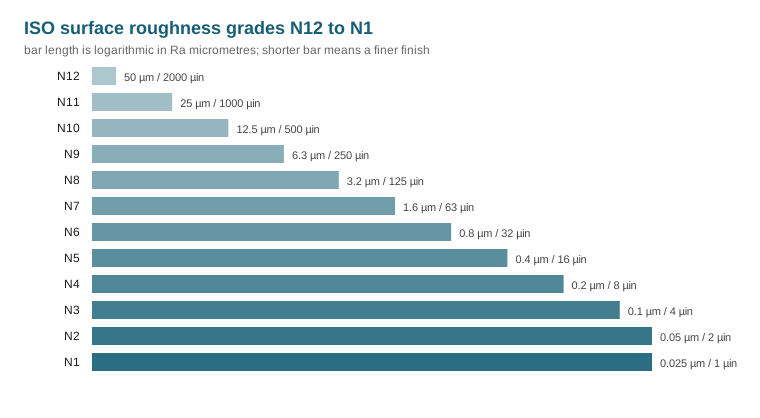
| ISO grade | Ra (µm) | Ra (µin) | RMS (µin) | CLA (µin) | Rt (µm) |
|---|---|---|---|---|---|
| N12 | 50 | 2000 | 2200 | 2000 | 200 |
| N11 | 25 | 1000 | 1100 | 1000 | 100 |
| N10 | 12.5 | 500 | 550 | 500 | 50 |
| N9 | 6.3 | 250 | 275 | 250 | 25 |
| N8 | 3.2 | 125 | 137.5 | 125 | 13 |
| N7 | 1.6 | 63 | 69.3 | 63 | 8 |
| N6 | 0.8 | 32 | 35.2 | 32 | 4 |
| N5 | 0.4 | 16 | 17.6 | 16 | 2 |
| N4 | 0.2 | 8 | 8.8 | 8 | 1.2 |
| N3 | 0.1 | 4 | 4.4 | 4 | 0.8 |
| N2 | 0.05 | 2 | 2.2 | 2 | 0.5 |
| N1 | 0.025 | 1 | 1.1 | 1 | 0.3 |
Common questions
What does N8 surface finish mean?
N8 is Ra 3.2 micrometres, or 125 microinches. The equivalent RMS reading is 137.5 microinch and the CLA figure is 125 microinch. Grades run from N12 (roughest, Ra 50) down to N1 (finest, Ra 0.025).
What does N7 surface finish mean?
N7 is Ra 1.6 micrometres, or 63 microinches. The equivalent RMS reading is 69.3 microinch and the CLA figure is 63 microinch. Grades run from N12 (roughest, Ra 50) down to N1 (finest, Ra 0.025).
What does N5 surface finish mean?
N5 is Ra 0.4 micrometres, or 16 microinches. The equivalent RMS reading is 17.6 microinch and the CLA figure is 16 microinch. Grades run from N12 (roughest, Ra 50) down to N1 (finest, Ra 0.025).
This page is an archival note for informational purposes only. It does not offer representation, evaluate claims, or create a professional relationship.