Stainless Steel Fabrication
Overview
Preserved shop record for santourian.com. The former plant is not quoting from this domain. What follows is drawn from the preserved pages of Santourian Manufacturing Inc. and stays inside the process language those pages used. The shop described itself as a precision sheet metal fabrication and CNC machine shop, a build-to-print manufacturer working from customer drawings and solid models. The preserved navigation lists the process families in the order the shop presented them: CAD, control, punching, machining, forming, engraving, assembly, quality. That sequence is a fair map of how work moved through the two buildings. The company dated its operation to 1981 and placed itself in Oceanside, in San Diego County, serving OEM and industrial sectors across the Southwest. Stainless steel appears in the preserved materials list among sheet, bar, plate, and structural stock. The grades nam
Details
ed are chromium nickel 301, 303, 304, and 316, and chromium 410 and 440. Those designations matter on the floor because they divide into austenitic and martensitic families with different forming and machining behavior. The 300-series grades work-harden, so a press brake operator plans bend sequences and tool radii around that tendency rather than fighting it. The 400-series grades machine more readily but behave differently in the weld cell. The shop listed stainless alongside aluminum 2000, 5000, 6000, and 7000 series, red metals such as brass, bronze, and copper, low and high carbon steels in CRS, HRS, CD, CF, and structural forms, exotic alloys including Inconel, Monel, 4130, 4140, and titanium, and plastics such as ABS, Acetal, Delrin, HDPE, G-classes, Lexan, and nylon. Stainless was one lane in a broad materials practice, not a specialty bolted on the side. Punching came early in the process chain. The preserved pages describe a new innovative punching cell providing automatic loading and unloading of material, and twin large Wiedemann 40-station turret punch presses. The word twin recurs, tied to doubled capacity. For stainless sheet, turret punching means planning hit sequences, tool clearances, and nesting so the work-hardening grade does not tear or distort at the cut edge. Automatic load and unload keeps the material moving through the cell without manual handling between hits. Forming follows punching. The preserved tolerance article is the clearest statement of the shop's process thinking. It notes that fifty years ago build-to-order sheet metal tolerances ran around plus or minus .06 inch, roughly 1.5 millimeters, limited by equipment accuracy. Today, the article says, normal production tolerances are around ten percent of that. Modern high speed equipment can position within .0028 inch, about .07 millimeter, and repeat within .002 inch, about .05 millimeter. The article is careful to call its ranges reasonable or practical, and notes that tighter tolerances can be achieved with dedicated tooling and special processing. It also names the variables that set practical limits: materials and methods influence hole-to-hole and fold-to-fold tolerances. Stainless sits squarely in that discussion. Its springback and work-hardening shift what a bend does compared with mild steel or aluminum, so fold-to-fold dimensions depend on tooling, radius, and grain direction as much as on machine positioning. Machining is the next lane. The preserved pages list three 10,000 rpm Haas vertical machining centers, with CNC milling at 4 axis, high speed drilling and tapping. For stainless components such as bus bars, heat sinks, frames, and ruggedized enclosures, machining covers the features that punching and forming cannot produce: tapped holes, milled pockets, profiled edges, and flatness-critical faces. The shop described its solid modeling capability and invited customers to compare it, which points to programming from models rather than from flat prints alone. Welding is a full-service certified welding shop in the preserved language. The listed standards are MIL-STD-2219, MIL-STD-1595, AWS D1.1, AWS D1.2, AWS D1.3, and AWS D1.6, with ISO 9000 compliant noted. Stainless weldments, frames, and chassis pass through that cell. The standards named cover aluminum, sheet steel, and stainless structural work, which matches the materials list. The preserved pages do not claim certifications beyond what they state, and this record repeats only what they state. Assembly and integration close the chain. The shop listed assembly, turnkey, and assembly integration among its services, producing build-per-print items such as assemblies, chassis, weldments, frames, ruggedized enclosures, heat sinks, and bus bars. Engraving appears in the navigation as its own step, which matters for stainless parts that need marked panels or identification without a separate vendor. Running alongside the process lanes is shop floor control. The preserved pages describe real time shop floor control, so a customer need not walk down the hall to see whether a job is done, and note that from Tokyo or Toledo a product can be built close to its customers in the Southwestern US. The phrase cyber manufacturing appears in the same passage, paired with solving problems together. The shop framed technology as a way to compete in a global economy hand in hand with customers. The preserved pages also record recognition: an excellence award from General Atomic Aeronautical, recognized for 100 percent quality and 100 percent on time delivery three years in a row. The shop described itself as build to print, prototype or high production, with delivery of metal fabrications and CNC machining that balances turn-around time with the rest of the job. That is the record as the pages left it.
Drill size reference
| Drill | Decimal inch | Millimetres |
|---|---|---|
| #1 | 0.2280 | 5.791 |
| #7 | 0.2010 | 5.105 |
| #13 | 0.1850 | 4.699 |
| #21 | 0.1590 | 4.039 |
| #29 | 0.1360 | 3.454 |
| #36 | 0.1065 | 2.705 |
| #43 | 0.0890 | 2.261 |
| #53 | 0.0595 | 1.511 |
| 1/16 | 0.0625 | 1.587 |
| 5/64 | 0.0781 | 1.984 |
| 3/32 | 0.0938 | 2.381 |
| 7/64 | 0.1094 | 2.778 |
| 1/8 | 0.1250 | 3.175 |
| 9/64 | 0.1406 | 3.572 |
| 5/32 | 0.1562 | 3.969 |
| 11/64 | 0.1719 | 4.366 |
| 3/16 | 0.1875 | 4.763 |
| 13/64 | 0.2031 | 5.159 |
| 7/32 | 0.2188 | 5.556 |
| 15/64 | 0.2344 | 5.953 |
| 1/4 | 0.2500 | 6.350 |
| 5/16 | 0.3125 | 7.938 |
| 3/8 | 0.3750 | 9.525 |
| 7/16 | 0.4375 | 11.113 |
| 1/2 | 0.5000 | 12.700 |
| F | 0.2570 | 6.528 |
| H | 0.2660 | 6.756 |
| L | 0.2900 | 7.366 |
| P | 0.3230 | 8.204 |
| S | 0.3480 | 8.839 |
| W | 0.3860 | 9.804 |
| Z | 0.4130 | 10.490 |
Common questions
What is a #1 drill bit in inches and millimetres?
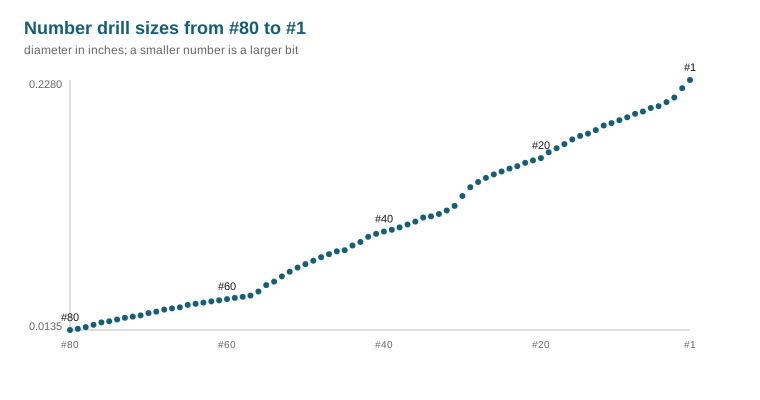
A #1 drill bit is 0.2280 in, which is 5.791 mm. Number drills run from #80 at 0.0135 in up to #1 at 0.2280 in, so a smaller number is always a larger bit.
What is a #7 drill bit in inches and millimetres?
A #7 drill bit is 0.2010 in, which is 5.105 mm. Number drills run from #80 at 0.0135 in up to #1 at 0.2280 in, so a smaller number is always a larger bit.
What is a #13 drill bit in inches and millimetres?
A #13 drill bit is 0.1850 in, which is 4.699 mm. Number drills run from #80 at 0.0135 in up to #1 at 0.2280 in, so a smaller number is always a larger bit.
This page is an archival note for informational purposes only. It does not offer representation, evaluate claims, or create a professional relationship.